Inventing Equality by Michael Bellesiles
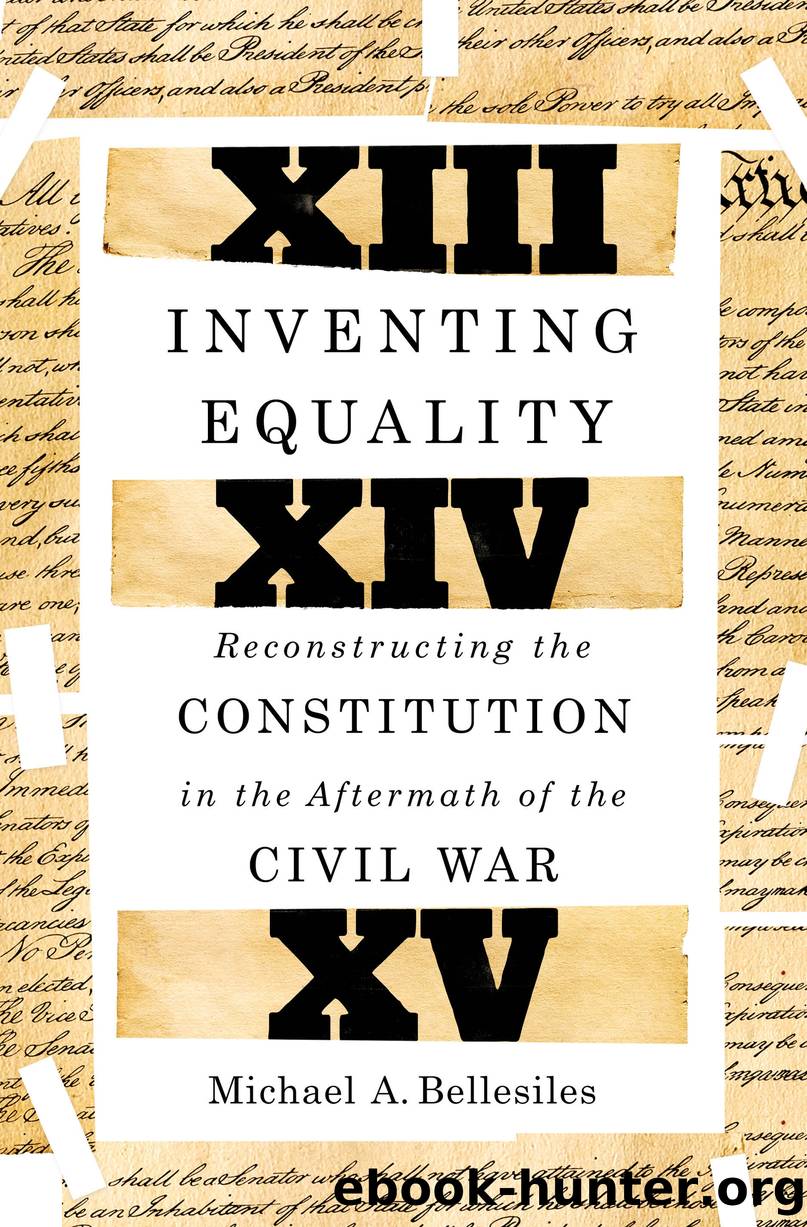
Author:Michael Bellesiles
Language: eng
Format: epub
Publisher: St. Martin's Publishing Group
* * *
At the start of 1866, congressional Republicans bypassed President Johnson and seized control of the nationâs future. They began by setting up the Joint Committee of Fifteen on Reconstruction. The Republican Party dominated the Thirty-ninth Congress, holding 145 of 191 House seats and 39 of 50 Senate seats. Just three Democrats sat on the committee, including Maryland senator Reverdy Johnson, at seventy the Senateâs oldest member, who had often sided with the Republicans during the war. William P. Fessenden, a depressed and sickly but adroit politician, chaired the committee, which included radicals Thaddeus Stevens and Elihu Washburne, the cynical manipulator Roscoe Conkling, who battled every effort at civil service reform, and the formidable constitutional lawyer John A. Bingham.
Bingham brought a particularly significant experience to the Committee of Fifteen. He had lost his reelection campaign in 1862 largely because of his unstinting advocacy of Lincolnâs authority to issue the Emancipation Proclamation. To reward his loyalty, Lincoln appointed Bingham as a judge advocate general in the army, a position he continued to hold after his return to Congress in the 1864 election. Secretary of War Edwin Stanton named Bingham to the special commission investigating Lincolnâs assassination. That inquiry convinced Bingham that the Confederate government had planned the attack and that Jefferson Davis had personally directed it. Though the commission held back from prosecuting Confederate officials in the name of national peace, Bingham remained suspicious of any move to restore power to the southern eliteâa group that, in his eyes, had attempted to destroy the Union, launched four years of bloody war, and assassinated the president.26
Bingham quickly emerged as the committeeâs pivotal advocate for further amending the Constitution. His pursuit of equality had deep roots, dating to his college days in the 1830s, when he had befriended Titus Basfield, a former slave who became an influential minister and lifelong friend and adviser, including during Binghamâs work on the Committee of Fifteen. Binghamâs constitutional creativity came from a unique understanding of Article IV, Section 2, which promised that the âCitizens of each State shall be entitled to all Privileges and Immunities of Citizens of the several States.â
Most of Binghamâs contemporaries read this passage, known as the comity clause, as indicating only that visitors to a state would be treated the same as its own citizens. In February 1859, Bingham formulated an alternative reading in response to Oregonâs application for admission to the Union. The new stateâs proposed constitution took upon itself the authority to determine who would enjoy the rights of citizenship within its borders, explicitly excluding black people from even settling in the state. This âinfamous atrocityâ aroused Binghamâs ire. Citing Article IV, Section 2, Bingham found no limit on the protection of citizensâ rights; the citizen of one state is a citizen of the United States and therefore entitled to all the privileges of citizenship. Oregon had no authority to exclude any U.S. citizen, nor could it mar the Constitution by the insertion of âany word of caste, such as white or black, male or female.
Download
This site does not store any files on its server. We only index and link to content provided by other sites. Please contact the content providers to delete copyright contents if any and email us, we'll remove relevant links or contents immediately.
| Anthropology | Archaeology |
| Philosophy | Politics & Government |
| Social Sciences | Sociology |
| Women's Studies |
Born to Run: by Christopher McDougall(7125)
The Leavers by Lisa Ko(6948)
iGen by Jean M. Twenge(5415)
Sapiens by Yuval Noah Harari(5370)
Spare by Prince Harry The Duke of Sussex(5196)
The Kite Runner by Khaled Hosseini(5178)
Machine Learning at Scale with H2O by Gregory Keys | David Whiting(4313)
Bullshit Jobs by David Graeber(4190)
Never by Ken Follett(3955)
Goodbye Paradise(3810)
Livewired by David Eagleman(3772)
Fairy Tale by Stephen King(3396)
A Dictionary of Sociology by Unknown(3085)
Harry Potter 4 - Harry Potter and The Goblet of Fire by J.K.Rowling(3073)
The Social Psychology of Inequality by Unknown(3029)
The Club by A.L. Brooks(2925)
Will by Will Smith(2919)
0041152001443424520 .pdf by Unknown(2845)
People of the Earth: An Introduction to World Prehistory by Dr. Brian Fagan & Nadia Durrani(2736)
